Re-instrumentalizing the Design Process
Speaking of design process: more than 20 years ago I opened 3DS Max and AutoCAD (and the like) for the first time, and until the last year or so it felt like a gradual development: tools getting better, slightly more advanced each cycle, new concepts sometimes, but still, same old drill and circular saw. Then AI showed up, stayed here for a little bit, and it became clear this isn’t the same kind of progress.
“AI changes everything” sounds silly, so let me be more specific. As a designer and a design technologist, I think instruments we reach for at each stage of the project are changing a lot; and our sense of what’s valuable in the outcomes will change too - because of that. The general architecture of how design happens looks durable so far though.
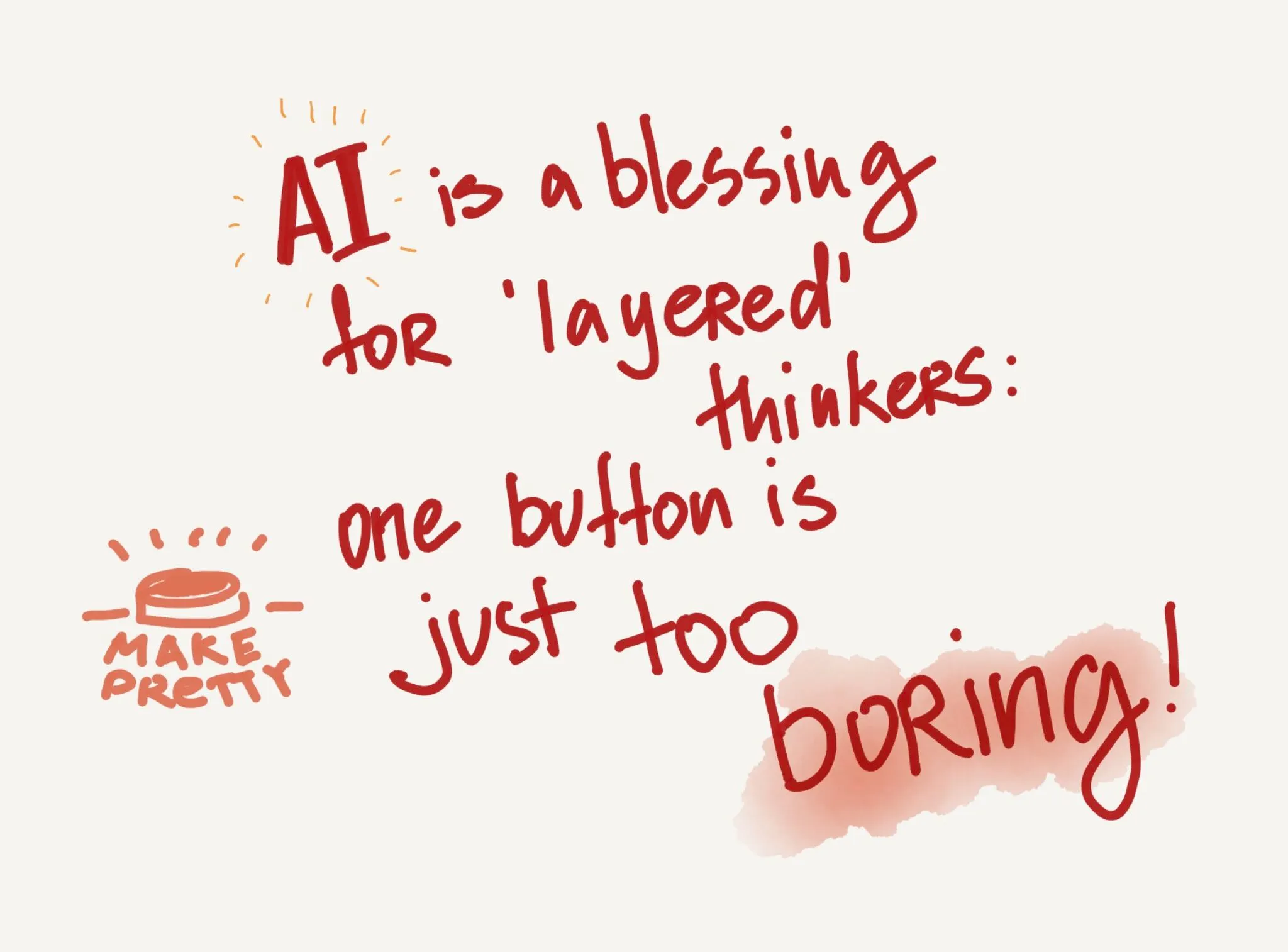
When I think about my own design process I find the idea of layering - like in Photoshop - useful: I dissect an ‘image’ into layers, from big moves down to detail, then shift perspective and do it again, then recombine. I’d say that’s how an analytical, engineering mind tends to work. We want to converge then diverge, induct then deduct, dissect then combine. We want to understand how things work because… of how we are. And we wouldn’t like one button, one prompt generation solution, that’s just no fun: let’s generate layers, let’s recombine perspectives, let’s frankenstein it - yasss, i feel excited just writing this.
Looks like AI is a blessing for ‘layered’ thinkers. The instruments get cheaper, faster, and weirder, AI works them for you. But the moves: convergence, divergence, layering, recombination - moves are the same.
So point is: AI is changing how we create layers of design, how we prototype, how we test - one move at a time. If you came here, because you like doing all of that, one button is just too boring.
Sidenote: it remains mind-boggling that since the Macintosh graphical interface (the 80s) we’re still sitting in front of a screen with a mouse-ish controller. Forty-something years and nobody has come up with a better way to interact with the machine. Not yet, Wispr Flow, not yet.